

Construction Site




2023
The structure of dreams.
Bruno Leitäo.
Construction Site, presented at the International Museum of Contemporary Art (MIAC), Castillo de San José in Lanzarote, reflects the consistent work of artist Nicolás Laiz Placeres. This exhibition serves as a prism through which multifaceted complexities at the confluence of urban development and tourism in the contemporary context are examined.
Through his focus, Laiz Placeres offers a profound unraveling of two paradigmatic concepts: modernist formalism in urban planning and the amorphism that serves as a metaphor for the experiential quest of tourism. This duality serves as the central axis of the narrative that unfolds in the exhibition space. Is amorphism a rock on a glass roof, or is it the integration of the organic into the stylized and rectilinear perfection of elements that invoke Brancusi or the Corbusian urban imaginary?
The first dimension delves into modernist formalism, an architectural and urbanistic legacy that has left an indelible impression on modern metropolises. The inspirations are evident: Ebenezer Howard’s utopian vision of the Garden City, Le Corbusier’s functional majesty of the Radiant City, Oscar Niemeyer’s exuberant Tropical Modernism, and, no less important, the symbiosis of Architecture and Nature proposed by César Manrique. These movements are not merely aesthetic; they embody ideologies and visions of how society should be organized, function, and develop. Laiz Placeres’s work strives to unravel and problematize these ideologies, questioning how they have shaped the aspirations and realities of our cities.
However, the counterpoint to this formalism is the exploration of the inherent amorphism in tourism. Tourism, at its core, is an act of escapism and discovery. It is an escape from routine but also a search for meaning, a way to find a purpose that transcends everyday monotony. This desire to encounter the other, to immerse oneself in the unknown, is a palpable manifestation of the intellectual—made emotional—need to find a purpose beyond the imposed structures of daily life. This transcendental quest, beyond the material, is also a longing for connection, an attempt to engage in a dialogue with the unfamiliar, to find resonances in the foreign.
However, Laiz Placeres does not shy away from the often-shadowy realities that accompany tourism. While it can be a way to celebrate diversity and seek mutual understanding, it also perpetuates power structures and has neocolonial implications. It is fertile ground for exploitation, where power dynamics can manifest in both obvious and insidious ways.
The convergence of these two concepts in Construction Site provides a rich platform for dialogue and reflection. By confronting the viewer with these dualities, Laiz Placeres invites introspection into how the formal structures we inhabit and the experiences we seek intersect, sometimes in complex and contradictory ways. The exhibition is not only a visual exploration but also an intellectual challenge, a call to question and reevaluate our relationship with the spaces we inhabit and the experiences we value.
Laiz Placeres’s proposal in Construction Site is a deep meditation on contemporary dynamics of urban development and tourism. It bears witness to the intersection of structure and experience, formalism and informalism, and the multiple tensions and convergences that arise from these interactions. In its entirety, Construction Site contributes to the academic and artistic discourse on the changing nature of our cities and the ethical and existential implications of tourism in the modern world.
The Construction Site exhibition is not only a visual representation but an interdisciplinary proposal that blends art, architecture, sociology, and philosophy. Láiz Placeres’s work suggests that the cities and spaces we inhabit, and the tourist experiences we pursue are more than mere physical manifestations or momentary pastimes; they are microcosms that reflect broader aspirations, desires, and, in many cases, inherent contradictions of contemporary society.
An observation of Construction Site reveals a profound exploration of sustainability. In an era marked by climate change, environmental degradation, and a growing disparity between urban and rural areas, how do we reconcile the constant demand for development with the imperative need for sustainability? If tourism, as Láiz Placeres suggests, is a way to seek a «higher sense,» then we must ask whether this sense aligns with the preservation of our planet and respect for the cultures and communities we visit.
This introspection inevitably leads to another fundamental theme: the ethics of tourism and urbanization. In a globalized world where mobility and exchange are more accessible than ever, we should be aware of the footprints we leave, both physically and culturally.
Láiz Placeres’s work is both a reflection of these contemporary dilemmas and a call to critical reflection. It invites viewers to be active participants in shaping and reshaping urban landscapes and tourist narratives, rather than passive consumers.
A closer analysis of Construction Site also highlights the importance of art as a means of communication and reflection. Art has the power to capture complexity, provoke, and challenge the status quo. Láiz Placeres maximizes this capacity, using his exhibition not only to represent but also to provoke critical reflection and enriching dialogue.
In summary, Construction Site is a multidisciplinary amalgamation that transforms MIAC into a center for debate, learning, and exploration. It serves as a reminder that in an ever-evolving world, it is essential to pause, reflect, and reconsider the paths we are forging, both for ourselves and for future generations.
The implications of Construction Site also extend to the role of museums and cultural spaces in contemporary society. The choice of MIAC, Castillo de San José in Lanzarote, as the venue for this exhibition is not coincidental. In an environment that combines history, architecture, and nature, there is a perfect synergy with the exhibition’s proposal.
Museums, traditionally seen as guardians of heritage and culture, face the challenge in the 21st century of redefining themselves and adapting to perhaps more demanding and certainly more diversified audiences. They are expected to be not only places of preservation but also spaces for innovation, discussion, and the construction of collective knowledge. In this regard, Laiz Placeres’s choice of MIAC is revealing. It demonstrates that contemporary art, far from being an isolated entity, can and should interact with its environment and thus generate a deeper and lasting impact on the community.
It is also relevant to note how Construction Site navigates between the local and the global. While the inspiration for the exhibition may have roots in universal concepts and issues, Láiz Placeres does not forget his geographical and cultural context. The influence of César Manrique, an artist who merged architecture and nature in Lanzarote, is palpable in Nicolás’s work. Manrique, like Laiz Placeres, understood that the balance between development and sustainability is not just an aesthetic but also an ethical matter.
The idea of seeking a «higher sense» when interacting with others, escaping routine, and connecting with nature is not merely a tourist phenomenon. It is a fundamental human quest that has been explored throughout history. The novelty in Construction Site lies in how this quest is presented in the contemporary context, where the contradictions of globalization, modernity, and sustainability intersect.
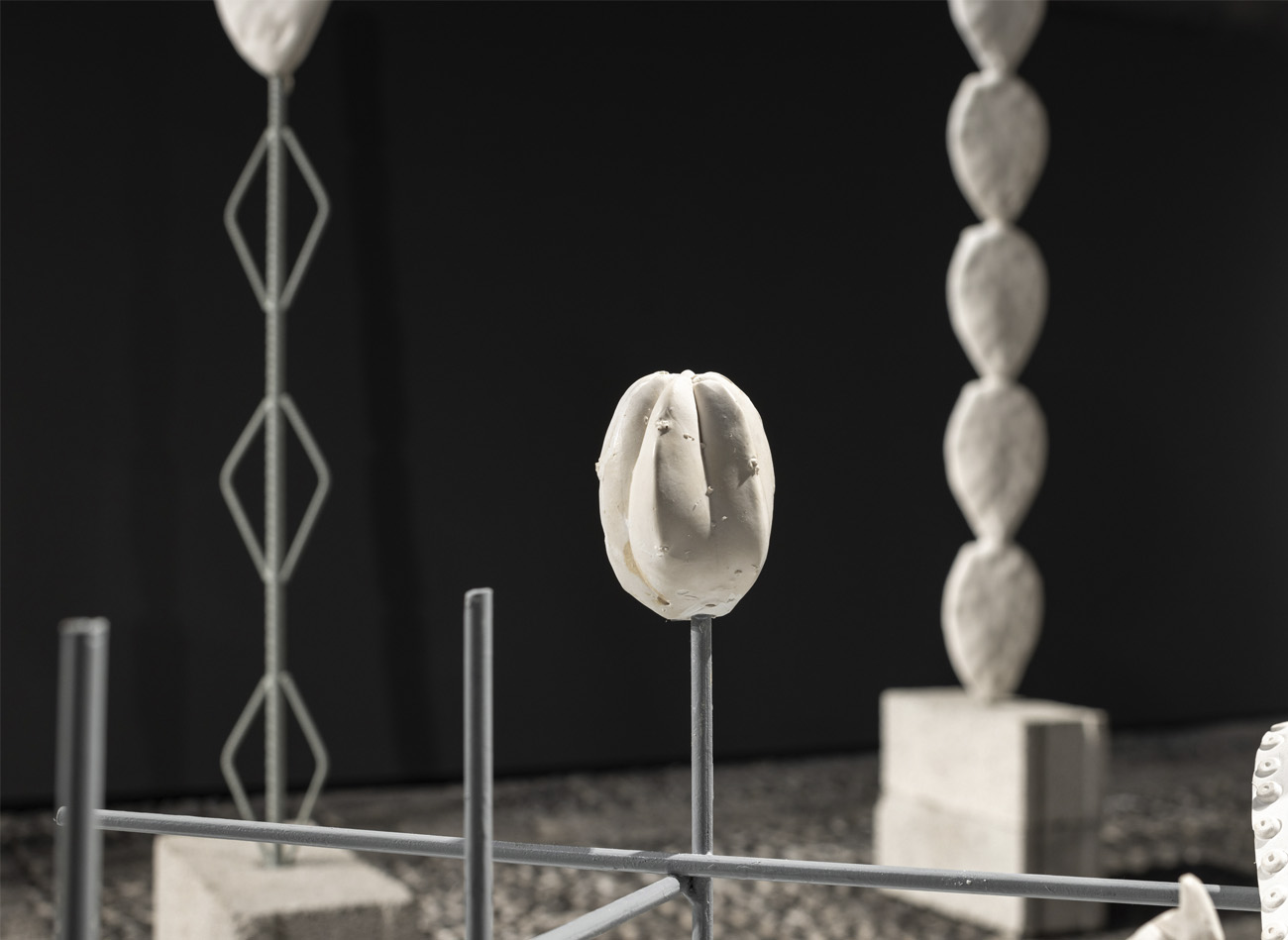
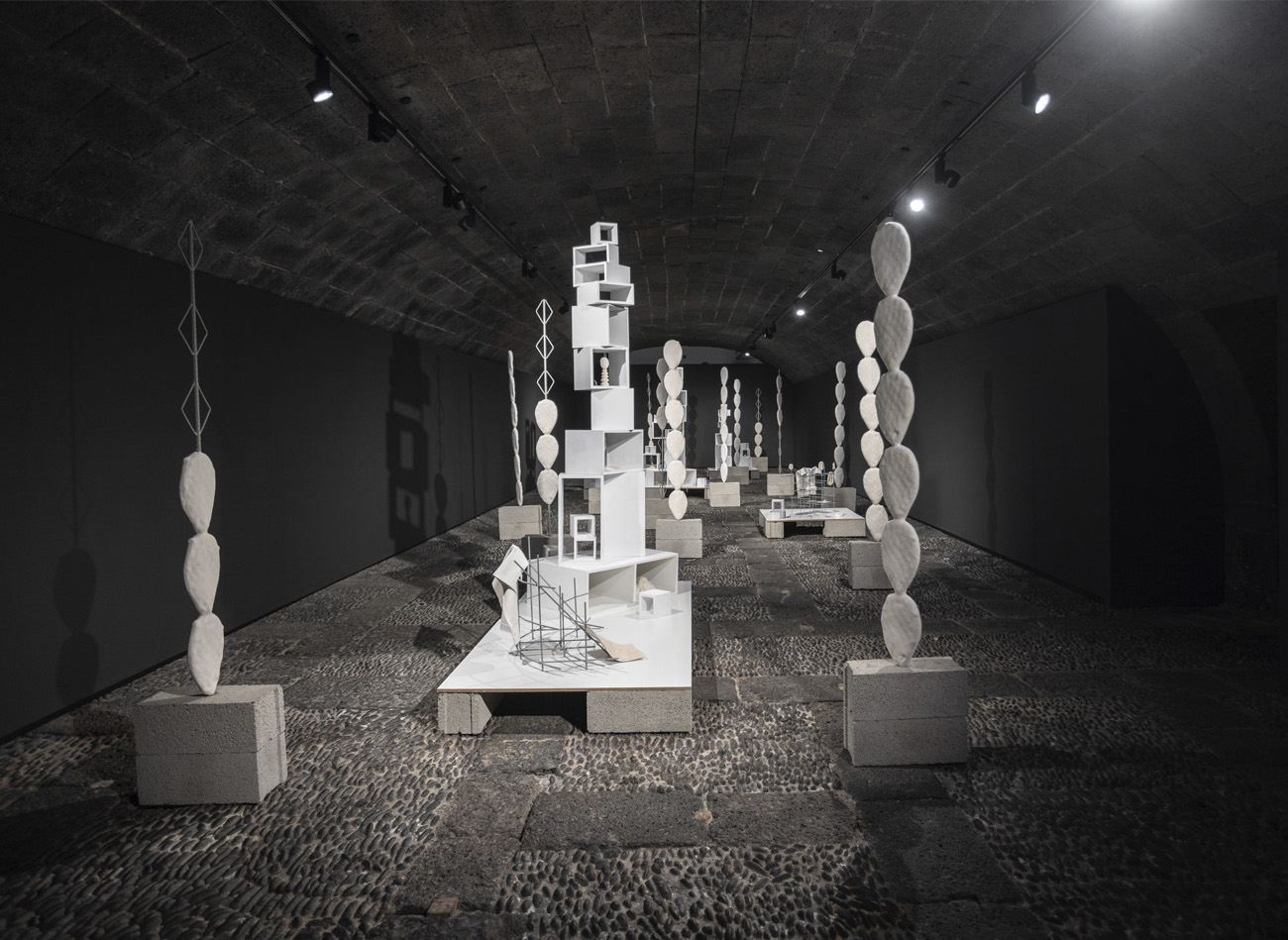
Finally, it is important to mention the emotional power of the exhibition. Beyond its profound conceptual content, Construction Site is also a sensory experience that appeals to the viewer’s emotions. The meticulously designed installation transports the visitor through a journey of discovery and reflection. It is this balance between the mind and emotion that marks Construction Site as a transcendental exhibition. Its white forms against a black background in the museum itself appear utopian, pristine, and essential, while the extraordinary economy of means focuses on a completely tangible reality, evident in the material details of the work: the industrial iron that supports the sculptures, as well as the concrete that composes them.
The dualistic structure of Construction Site also reflects a broader contemporary phenomenon: the tension between individualism and collectivism, between personal desire for exploration and the collective impact of our actions. While modernist formalism reflects an organized and standardized desire for development, informalism highlights the diversity and multiplicity of individual experiences and perspectives. However, it is important to recognize that these dualities are not necessarily opposites; they can coexist and, in fact, inform each other. Laiz Placeres’s work suggests that a complete understanding of the contemporary world requires an approach that encompasses both perspectives.
Instead of offering an idealized or sterilized view of tourism, the artist presents a more complex and nuanced picture and reminds us that every choice has consequences and that there are often real human costs associated with our decisions.
In essence, Construction Site stands as a deep and erudite meditation on the complexities, contradictions, and challenges posed by the modern world. By confronting the structured formalism of modernist urbanism with the inherent informalism of tourist experiences, Nicolás Laiz Placeres creates a space for debate and reflection. This exhibition unquestionably testifies to Laiz Placeres’s commitment to exploring issues that, while rooted locally, resonate globally in a decidedly contemporary way and using art as a radical tool for this purpose.
Installation
Building block, iron, dm, resin, fiber. 2023